
Sidestream Capnography Device: How It Works, Uses and Benefits
A sidestream capnography device is a respiratory monitoring system that continuously measures carbon dioxide in a patient's exhaled breath. It provides healthcare professionals with information about ventilation, including end-tidal carbon dioxide (ETCO₂), and typically displays both a numerical reading and a capnography waveform.
Unlike mainstream capnography, where the CO₂ sensor is positioned directly at the patient's airway, a sidestream system draws a small sample of exhaled gas through a sampling line to a sensor located inside or near the monitor. This configuration allows sidestream capnography to be used in a variety of clinical environments and, with appropriate interfaces, with both intubated and non-intubated patients.
In this guide, we explain what sidestream capnography is, how the technology works, what healthcare professionals monitor with it, and how to choose an appropriate device.
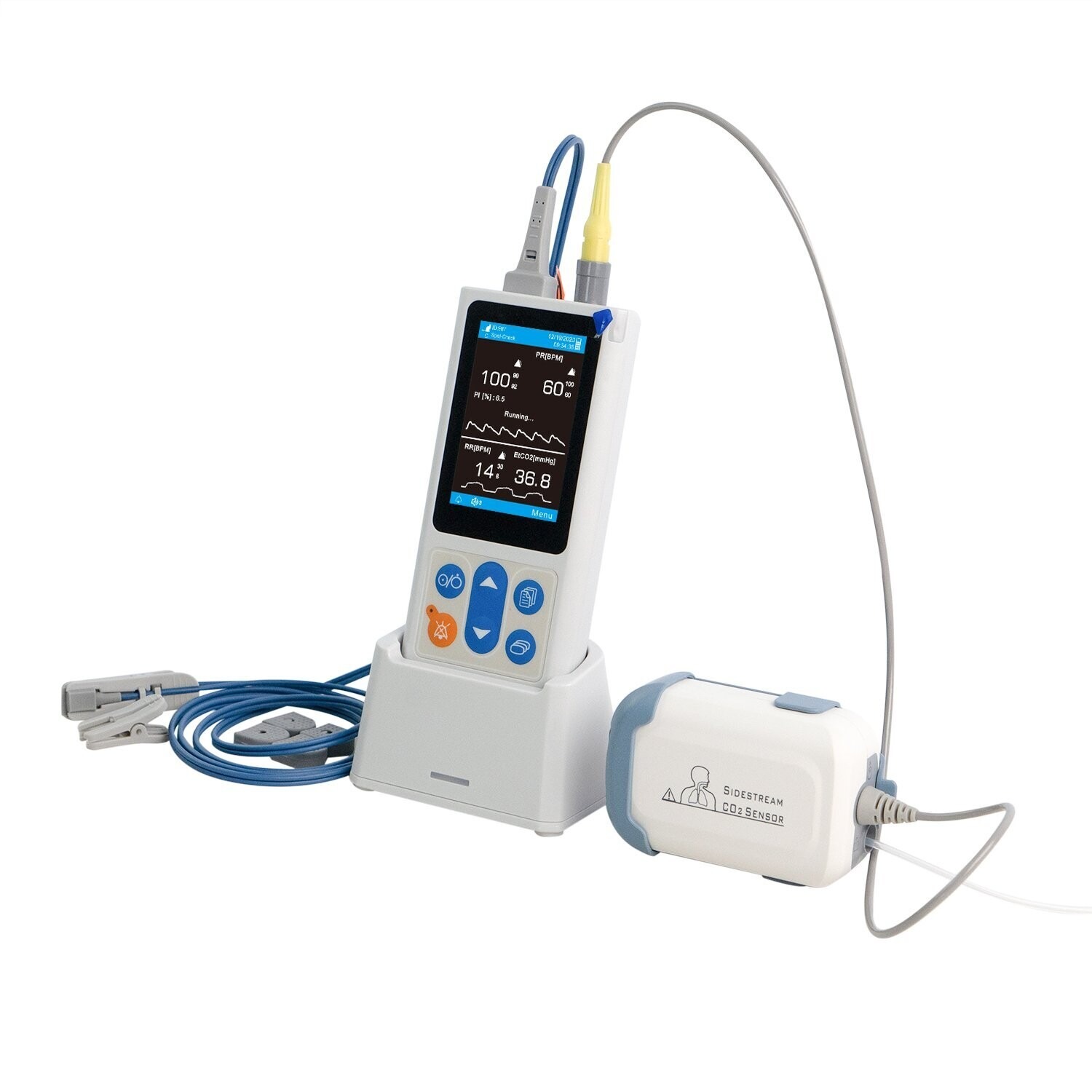
What Is a Sidestream Capnography Device?
A sidestream capnography device is a type of capnograph in which the carbon dioxide sensor is located away from the patient's airway.
A sampling line continuously draws a small amount of respiratory gas from the patient to the monitor. The device then analyses the concentration of CO₂ and generates capnography information.
This typically includes:
- End-tidal carbon dioxide (ETCO₂)
- Respiratory rate
- Numerical CO₂ values
- A real-time capnogram or CO₂ waveform
Some multiparameter capnography devices may additionally measure SpO₂ and pulse rate, although these functions depend on the particular model.
Capnography differs from basic capnometry because capnography provides both numerical information and a graphical waveform representing changes in exhaled CO₂ throughout the respiratory cycle.
What Is ETCO₂?
ETCO₂ stands for end-tidal carbon dioxide.
It represents the level of carbon dioxide measured toward the end of an exhaled breath.
Carbon dioxide is produced through metabolism, transported through the bloodstream to the lungs, and removed during exhalation. Monitoring exhaled CO₂ therefore provides healthcare professionals with real-time information related to a patient's ventilation.
A capnography device does more than simply display an ETCO₂ number. The capnogram waveform can provide additional information about the respiratory cycle and changes in ventilation.
How Does a Sidestream Capnography Device Work?
The basic process can be understood in four stages.
1. Exhaled Gas Is Collected
A compatible airway adapter, sampling cannula, or other patient interface collects a small sample of respiratory gas.
2. Gas Travels Through the Sampling Line
The sidestream system continuously draws the gas through narrow tubing toward the monitor.
3. CO₂ Is Analysed
The CO₂ sensor is located remotely from the patient's airway, typically within the monitoring device.
4. The Capnogram Is Displayed
The monitor processes the sampled gas and displays the measured ETCO₂ value and capnography waveform.
Because the respiratory sample must physically travel through tubing before reaching the sensor, sidestream systems can have a small measurement delay compared with a sensor positioned directly at the airway.
What Does a Capnogram Show?
The graphical waveform produced by capnography is called a capnogram.
Rather than providing only one CO₂ number, the waveform represents changes in carbon dioxide concentration throughout the breathing cycle.
Healthcare professionals can assess the numerical ETCO₂ value together with the waveform pattern and other clinical information.
Changes in the waveform may provide clinically useful information concerning ventilation and airway status. Capnography is therefore valuable because it provides continuous, breath-by-breath respiratory information rather than an isolated measurement.

What Is a Sidestream Capnography Device Used For?
Sidestream capnography may be incorporated into respiratory monitoring across several clinical environments.
Depending on the device, patient interface, and applicable clinical protocol, capnography may be encountered in:
- Operating rooms
- Intensive care units
- Emergency departments
- Procedural and sedation environments
- Recovery areas
- Patient transport
- Pre-hospital care
- Respiratory monitoring environments
Capnography provides continuous information about ventilation and can help healthcare professionals identify changes such as apnea, hypoventilation, hyperventilation, or airway obstruction in the appropriate clinical context.
Sidestream Capnography for Intubated and Non-Intubated Patients
One important characteristic of sidestream technology is its flexibility.
For an intubated patient, a sampling adapter can be incorporated into the breathing circuit.
For an appropriately selected non-intubated patient, compatible nasal or oral-nasal sampling interfaces may allow exhaled CO₂ to be sampled during spontaneous breathing.
This is one reason sidestream technology is used across a relatively broad range of respiratory monitoring applications.
The exact patient population supported by a particular device must always be confirmed from that device's manufacturer instructions.
Sidestream vs Mainstream Capnography
There are two principal configurations used for clinical capnography: sidestream and mainstream.
The fundamental difference is the location of the CO₂ sensor.
| CO₂ sensor | Located away from patient | Located at airway |
| Gas sampling | Gas travels through sampling tube | Measurement occurs directly at airway |
| Sampling line | Required | Generally not required in the same manner |
| Intubated monitoring | Possible | Common |
| Non-intubated monitoring | Possible with appropriate interface | More device/interface dependent |
| Sensor weight at airway | Lower | Sensor assembly positioned at airway |
| Response | Small transport delay possible | More immediate measurement |
| Moisture/secretions | Can affect sampling line | Different contamination considerations |
Neither technology should automatically be considered the best option for every clinical situation.
Research comparing the two approaches shows that measurement characteristics can differ. Mainstream systems can offer advantages for certain absolute capnographic measurements, while sidestream systems provide useful respiratory information and greater flexibility in some monitoring configurations.
Compatible nasal or oral-nasal sampling interfaces may allow exhaled CO₂ to be sampled during spontaneous breathing.
This is one reason sidestream technology is used across a relatively broad range of respiratory monitoring applications.
The exact patient population supported by a particular device must always be confirmed from that device's manufacturer instructions.
Advantages of a Sidestream Capnography Device
Flexible Patient Interfaces
Sidestream systems can work with different compatible sampling interfaces, making them adaptable to various clinical situations.
Remote CO₂ Sensor
Because the main CO₂ sensor is not positioned directly at the airway, the patient-side assembly can be relatively lightweight.
Non-Intubated Monitoring
With appropriate sampling interfaces, sidestream capnography can be used for spontaneously breathing, non-intubated patients.
Continuous Respiratory Information
Capnography provides ongoing ETCO₂ measurements and waveform information rather than relying on occasional isolated observations.
Portable Options
Sidestream capnography technology can be incorporated into handheld monitors as well as larger multiparameter monitoring systems.
Limitations of Sidestream Capnography
Sidestream technology also has practical limitations that healthcare facilities should understand.
Sampling Delay
The respiratory sample must travel from the patient through tubing before reaching the CO₂ sensor. This can introduce a small delay.
Sampling-Line Blockage
Water vapour, condensation, or respiratory secretions may interfere with or obstruct the sampling line. Appropriate filters and manufacturer-specified consumables can help manage this issue.
Sampling Interface Matters
The quality of the respiratory sample can depend on factors such as patient breathing pattern, cannula or airway interface design, and supplemental oxygen flow.
Device-Specific Performance
Measurement range, response time, sampling rate and supported patient populations vary between devices.
For this reason, procurement decisions should be based on the specifications of the particular capnography device rather than assuming that all sidestream systems perform identically.
Capnography vs Pulse Oximetry
Capnography and pulse oximetry are related monitoring technologies, but they measure different physiological parameters.
Capnography measures carbon dioxide in exhaled respiratory gas and provides information related to ventilation.
Pulse oximetry measures peripheral oxygen saturation (SpO₂) and provides information about oxygenation.
| Measures exhaled CO₂ | Measures oxygen saturation |
| Provides ETCO₂ | Provides SpO₂ |
| Provides capnogram waveform | Provides oxygen saturation/pulse information |
| Monitors ventilation | Monitors oxygenation |
They should therefore be viewed as complementary monitoring technologies, not interchangeable ones.
Some modern portable monitors combine capnography, SpO₂ and pulse-rate measurement within a single device.
What to Consider When Choosing a Sidestream Capnography Device
Healthcare facilities purchasing a sidestream capnography device should compare more than price.
Important specifications may include:
ETCO₂ Measurement Range
Check whether the measurement range is appropriate for the intended clinical application.
Respiratory Rate Measurement
Determine whether respiratory rate is measured and what range and accuracy the manufacturer specifies.
Capnogram Display
A clear waveform can make respiratory monitoring easier for clinical personnel.
Alarm Functions
Look for appropriate audible and visual alarms and configurable alarm limits.
Patient Compatibility
Confirm whether the exact model is approved by the manufacturer for adults, paediatric patients, neonates or a combination of patient groups.
Do not assume compatibility simply because another model from the same manufacturer supports those patients.
Battery Operation
For portable monitoring, consider:
- Battery type
- Operating duration
- Charging time
- Low-battery warning
- AC operation
Sampling Consumables
Check availability and cost of compatible:
- Sampling lines
- Filters
- Cannulas
- Airway adapters
- Water traps, where applicable
Consumable availability can have a significant effect on the long-term practicality of a monitoring system.
Portability
For emergency departments, transport teams and mobile clinical applications, consider device size, weight and battery life.
Additional Parameters
Some capnography monitors also incorporate:
- SpO₂
- Pulse rate
- Other patient-monitoring parameters
A combined system may be useful where multiple physiological parameters need to be monitored simultaneously.
Portable Sidestream Capnography Devices
Portable capnography has expanded the environments in which continuous ETCO₂ monitoring can be performed.
A compact portable sidestream capnography device can be useful when the monitor needs to move between treatment areas or accompany a patient.
Portable models should be evaluated for:
- Physical dimensions
- Weight
- Battery runtime
- Display visibility
- Alarm audibility
- Sampling-line compatibility
- Durability
- Available accessories
For procurement teams, these practical considerations can be just as important as the core ETCO₂ measurement specification.
CA10S Sidestream Capnography Device
Premium Medical Equipment Innovations supplies the CA10S Sidestream Capnography Device, a compact monitor designed for professional respiratory monitoring.
The CA10S combines sidestream capnography with monitoring of:
- ETCO₂
- Airway respiration rate
- SpO₂
- Pulse rate
This makes it suitable for healthcare facilities looking for a compact device combining respiratory carbon dioxide monitoring and pulse oximetry functions.
Frequently Asked Questions
What is a sidestream capnography device?
A sidestream capnography device measures exhaled carbon dioxide by drawing a small respiratory gas sample through a sampling tube to a CO₂ sensor located away from the patient's airway.
What does sidestream capnography measure?
Its primary measurement is exhaled carbon dioxide, including end-tidal carbon dioxide (ETCO₂). Capnography also provides a waveform showing changes in CO₂ throughout the respiratory cycle.
Depending on the monitor, additional parameters such as respiratory rate, SpO₂, and pulse rate may also be available.
What is the difference between sidestream and mainstream capnography?
In sidestream capnography, respiratory gas is transported through a sampling line to a remote CO₂ sensor. In mainstream capnography, the sensor is positioned directly at or close to the patient's airway.
Can sidestream capnography be used without intubation?
Yes, sidestream technology can support non-intubated monitoring when an appropriate compatible sampling interface is used.
Is capnography the same as pulse oximetry?
No. Capnography measures exhaled carbon dioxide and provides information about ventilation, while pulse oximetry measures peripheral oxygen saturation.
What is ETCO₂?
ETCO₂ means end-tidal carbon dioxide. It refers to carbon dioxide measured at the end of exhalation and is used as part of respiratory and ventilation monitoring.
Can a capnography device measure SpO₂?
Some models can. Capnography itself concerns exhaled CO₂, but manufacturers may integrate a pulse oximetry module into the same monitor.
Where can I buy a sidestream capnography device in South Africa?
Premium Medical Equipment Innovations supplies capnography and patient-monitoring equipment for hospitals, clinics, and other healthcare facilities. Buyers can enquire about the CA10S Sidestream Capnography Device for current availability and procurement requirements.
Conclusion
A sidestream capnography device provides continuous respiratory monitoring by drawing exhaled gas through a sampling line and analysing its carbon dioxide concentration away from the patient's airway.
Its ability to provide ETCO₂ values, respiratory information and a continuous capnogram waveform makes capnography an important monitoring technology in appropriate clinical environments.
Sidestream systems also offer flexibility because they can be configured for intubated patients and, with appropriate sampling interfaces, non-intubated patients. However, sampling delays, moisture, secretions, patient-interface design, and device-specific specifications must be considered when selecting equipment.
For healthcare facilities seeking a compact monitoring solution, the CA10S Sidestream Capnography Device combines ETCO₂ and respiratory-rate monitoring with SpO₂ and pulse-rate measurement.